Acquisition empowers property managers with AI-powered rent analysis and smart pricing tools
ESTERO, FL—October 15, 2025 — Rentvine announced today that it has acquired RentFinder.ai, an AI-powered rent analysis platform that helps property managers and owners make faster, smarter pricing decisions.
The acquisition adds AI-powered rent intelligence and predictive pricing tools that analyze comps, trends, and lease performance. As a leader in AI innovation for residential property management, Rentvine will integrate RentFinder’s machine learning technology directly into its platform, to deliver smarter, real-time pricing insights exactly where property managers work.
“Rentvine’s commitment to building the most intelligent, AI-connected platform in the industry is now stronger with RentFinder,” said Dave Borden, CEO of Rentvine. “Bringing them into the Rentvine family aligns perfectly with our belief that property managers deserve real intelligence – not just information—and AI solutions exactly when and where they need it.”
Smarter leasing decisions, built into the platform
Property managers will soon be able to:
Instantly view market-aligned rent recommendations when creating or renewing leases
Analyze real-time pricing trends by unit type, location, and performance
Eliminate manual rent research with AI-sourced rental comps
Empower teams with tools that reduce vacancy loss and maximize NOI
These new capabilities will complement Rentvine’s existing end-to-end lifecycle automation, from lead to lease to renewal, streamlining operations for leasing teams while driving better outcomes for owners.
A continued focus on AI and innovation
The RentFinder acquisition builds on a series of AI-powered features, product rollouts, and strategic partnerships aimed at giving property managers more control, smarter insights, and less operational friction. By doubling down on artificial intelligence, Rentvine is helping property managers streamline decisions, improve accuracy, and scale with confidence.
“We built RentFinder to simplify and strengthen rent analysis for property managers,” said Charles Thompson, CEO of RentFinder. “We’re grateful to Rentvine for recognizing that vision and excited for them to lead the path forward. Our clients are in great hands with a company that shares our vision and commitment to AI-driven innovation.”
Key highlights
Rentvine acquires RentFinder.ai in October 2025
AI-driven pricing and rental comp tools will be embedded directly into Rentvine
Streamlines leasing workflows and improves pricing confidence for property managers
Part of Rentvine’s ongoing investment in smarter, more connected property management
Yverdon-les-Bains, Switzerland – 13 October 2025 – Ecorobotix, the global leader in AI-powered Ultra-High Precision (UHP) spraying, is driving the future of sustainable agriculture with innovations that improve crop health and efficiency. Building on rapid growth, proven field results, and a strong financial foundation with $150 million raised in Series C ($45m, 2024) and Series D ($105m, 2025), the company will present its latest advancements at Agritechnica this November in Hanover.
Central to Ecorobotix’s momentum is its Plant-by-Plant™ AI technology, which can distinguish and treat each individual plant with unmatched precision, using a spray footprint of just a few centimeters. This approach reduces the use of pesticides and other crop protection products by as much as 95% while maintaining effectiveness. For growers, the benefits are far-reaching: the safe use of non-selective products, lower input costs, compliance with increasingly strict regulations, and ultimately, higher yields.
Fueling Innovation Through Investment These new advances are made possible thanks to the company’s strong backing from global investors. The Series D round was led by Highland Europe, one of the continent’s top venture capital funds, with ECBF and McWin Capital Partners also joining as new investors.
“These latest investment rounds have allowed us to accelerate our innovation, expand into new crop types, broaden our product range, and bring our advanced crop algorithms to market faster,” said Dominique Mégret, CEO of Ecorobotix. “Thanks to the trust of our investors, we are scaling a proven solution to help deliver better-quality food for the world.”
Showcasing New Innovation at Agritechnica 2025 This November at Agritechnica, Ecorobotix will unveil its latest innovation, setting a new standard for crop protection worldwide.
“Farmers today face rising costs, labor shortages, and pressure to reduce inputs while still producing more food,” added Mégret. “Our new innovation takes precision even further to help them meet those challenges.”
About our New Investors
Highland Europe Highland Europe invests in exceptional growth-stage technology and consumer companies. Formally launched in 2012, Highland Europe has raised over €2.75 billion. Highland’s collective history of investments across the US, Europe and China includes 45+ IPOs, 150+ M&A exits and 40 billion-dollar-plus companies.
ECBF The European Circular Bioeconomy Fund (ECBF) is the leading venture capital fund dedicated to accelerating Europe’s transition to a sustainable, circular bioeconomy. With €300 million under management, ECBF invests in growth-stage companies. As an Article 9 SFDR fund, ECBF combines rigorous ESG standards with deep industry expertise to scale impactful innovations.
McWin Capital Partners McWin Capital Partners (“McWin”) is a specialist private equity and venture capital firm, dedicated to the food ecosystem. With deep industry expertise across three business segments; Food Tech, Foodservice and Restaurants, McWin’s purpose is to lead the food industry through positive change and create value on behalf of investors and portfolio companies of the McWin Funds by leveraging its scale, network and experience to deliver outstanding returns.
Ecorobotix also acknowledges the vital support of its long-term partners such as 4FOX Ventures, AQTON, BASF Venture Capital, Capagro, Cibus Capital, Flexstone Partners, Fondation Domaine de Villette, Meritech, Stellar Impact, Swisscanto, Swisscom Ventures, and Yara Growth Ventures.
About Ecorobotix Ecorobotix is a Swiss B Corporation® certified company whose mission is to transform agriculture through artificial intelligence and ultra-precise spraying technologies. With more than 25 crop algorithms now supported, its flagship product, ARA, is the world’s most versatile ultra-high-precision sprayer, capable of targeting specific crops as well as different types of weeds. Present in more than 20 countries in Europe, the Americas, and Oceania, Ecorobotix is redefining the standards of sustainable crop protection.
Enterprises have reached a tipping point in their AI investments. Pilots are widespread, but most companies have yet to translate those experiments into full workflow transformations. Their ability to capture the value that AI promises depends on integrating an increasing number of task and function-specific AI agents and systems across their businesses.
n8n has built the missing piece that enterprises need in order to translate their AI investments into real, durable value for their organizations. Its central system of record enables companies to build, evaluate, observe, and orchestrate agentic automations across their global operations, all while integrating directly into their existing workflows through over 1,000 native integrations, APIs, ETL connectors, and MCPs.
Accel’s Ben Fletcher and n8n’s Jan Oberhauser together in Berlin.
Today, we’re pleased to announce that Accel has led the Series C in n8n’s AI-native workflow automation platform. This funding round follows explosive, capital-efficient growth over the past year that has seen n8n become the underlying infrastructure for orchestrating and integrating agents into leading enterprises. We’re grateful to be joined by a variety of angels and strategic partners, including CrowdStrike’s George Kurtz, NVIDIA’s NVentures, and Deutsche Telekom’s T.Capital.
Previous generations of automation software relied on “if this, then that” deterministic logic. It’s a fundamental mismatch for agentic AI workflows, and diminishes the potential value LLMs promise. n8n has built the automation and orchestration layer for the AI era: today, more than 80% of workflows built on n8n embed AI agents.
n8n has dramatically expanded the share of work that can be automated. Teams can fully customize workflows, mixing AI agents with deterministic steps and team inputs where required. The range of use cases on n8n is vast: AI builders define full backend logic. Fortune 500 companies standardize operations spanning IT, finance, marketing automation, and security orchestration. System integrators have transformed customer support, sales, and DevOps with easy AI automations. No matter where customers are on their AI journey, n8n makes it easy to unlock real value and efficiency gains.
What truly sets n8n apart is its radically open “Fair Code” model and the community it has inspired. n8n has become a Top 50 GitHub Project with over 145,000 stars, and is now supported by a vibrant community of more than 700,000 active developers. n8n users also tend to be n8n evangelists: extending it through workflow templates and integrations, and spreading the word across online forums. Community members now organize over 60 community events around the world each year. In this, we’ve recognized a similarity with some of Accel’s most notable investments – Atlassian, Slack, Vercel, Webflow – that built effusive, loyal communities centered around great products.
n8nevents around the world focused on builders
At Accel, we’ve long believed in partnering with the builders creating the foundational tools powering software. Accel portfolio companies Cursor, Linear, Lovable, Supabase and Vercel are rapidly defining the next-gen AI stack. n8n is the next step of this thesis, providing the open, community-first operating system to embed AI into daily work. We’re grateful to Jan and his team for trusting Accel as a partner for their next phase of global growth and we look forward to the remarkable journey ahead.
Telmai’s new Data Reliability Agents deliver AI-ready data at the lake, validated in real-time, with autonomous detection, resolution, and natural language interfaces for agentic workflows.
SAN FRANCISCO, Oct. 7, 2025 /PRNewswire/ — Telmai, the AI-powered data observability platform, today announced its Agentic offerings to make enterprise data truly Autonomous-Ready. These new capabilities ensure agentic AI workflows can communicate, decide, and execute actions on real-time trusted data with minimal human oversight.
Agentic AI significantly changes the requirements for how organizations manage their data and thus their data quality (DQ). Because Agentic AI requires low-latency and real-time access to validated data, it’s imperative that data quality happens right at the source, not downstream, where most companies focus their DQ efforts today.
But validation alone isn’t enough. AI agents also need to understand whether data is truly fit for purpose in the context of their actions. This involves delivering contextual information about data health as metadata into catalogs and semantic layers that AI agents can access.
Only when trust and context are combined can AI agents operate responsibly and enterprises deploy them with real confidence.
Telmai has the unique ability to continuously validate, monitor, and enrich data with quality signals at the lake and can push that data quality metadata for consumption by agents. This creates the trusted foundation that autonomous AI products need to operate reliably and at scale.
With Telmai’s latest product launch, AI agents can continuously access reliable data and the critical data quality context needed to automate downstream workflows.
Real-Time, Continuous, Agentic AI-Ready Data
At the core of this update is the introduction of Telmai’s MCP-compliant server, which enables LLM-powered agents like Claude, Bedrock, or Vertex to query Telmai directly. Telmai continuously validates data, whether structured, semi-structured, or unstructured. Additionally, it generates comprehensive data quality metadata alongside the validated data, providing essential context on data health to ensure the data is reliable and AI-ready. Through the MCP layer, AI agents can access and retrieve validated data and metadata into their agentic workflows, eliminating the need for third-party transformations or complex workarounds.
“In the era of model commoditization, true competitive advantage will emerge from trustworthy, dynamic, and contextually aware data,” said Sanjeev Mohan, industry analyst and principal at SanjMo. “Telmai’s latest release is a big step in this process. It offers continuous validation and contextual metadata that enable AI agents to act responsibly, while reducing the operational debt that has long hindered enterprise adoption.”
Natural Language AI Assistants & Decentralized Data Trust
Building on this foundation, Telmai is introducing a suite of AI assistants called Data Reliability Agents accessible through natural language interfaces, enabling both technical and non-technical users to interact directly with the platform. This decentralization means that ownership of data reliability no longer sits solely with engineering, accelerating time to value by making platform management and critical data quality insights accessible and actionable to all relevant stakeholders.
Autonomous Detection and Remediation
Telmai’s Data Reliability Agents enable autonomous detection and resolution of data anomalies. These intelligent agents continuously monitor data pipelines for irregularities and provide clear, plain-language explanations of root causes. Identifying and resolving complex data quality issues that once required deep technical expertise are now easily understood and addressed by both technical and business teams. Beyond detection, the Data Reliability Agents provide actionable recommendations and assist in generating data quality rules tailored to newly identified anomalies.
Furthermore, these Data Reliability Agents augment existing automated workflows, such as ticket creation and alert triggers, to help data teams proactively adapt and drive continuous improvement in their data quality processes.
This comprehensive approach closes the loop from detection through triage and remediation, ensuring that data being fed into the downstream processes is not only trustworthy but consistently ready for autonomous consumption and decision-making.
“As AI agents take the reins of decision-making, we believe autonomy should never come at the cost of reliability,” said Mona Rakibe, Co-founder & CEO of Telmai. “With these updates, Telmai is laying the groundwork for true intelligent automation and allowing enterprise data teams to shift their focus to driving measurable business value via Agentic AI.”
About Telmai
Telmai is a data observability platform company that enables enterprise data owners to monitor and detect real-time data issues. The platform leverages AI to monitor all data passing through the data pipeline before entering the data warehouse, protecting downstream systems and analytics used for decision-making. Telmai’s open architecture supports anomaly detection closest to data sources and works over complex data types with native support for nested and multi-valued attributes.
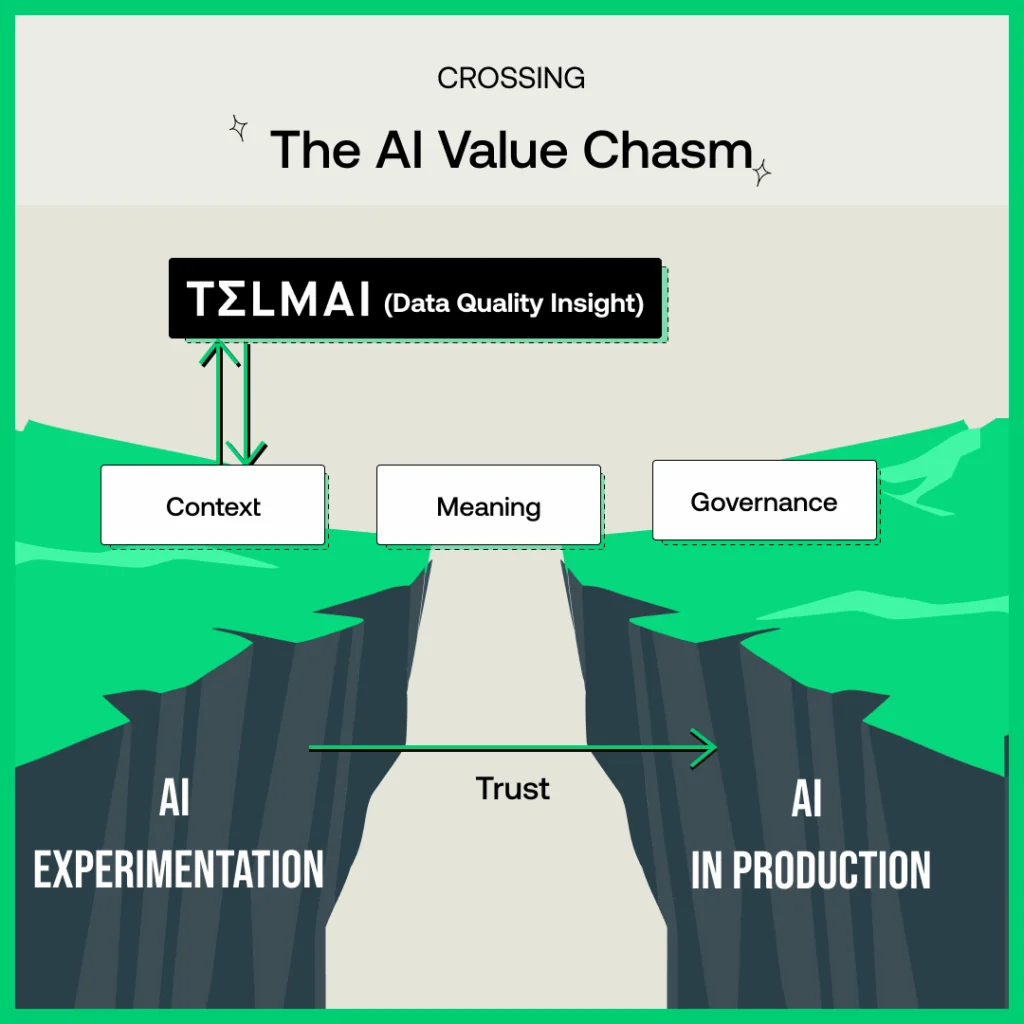
AI pilots fail not because models don’t work, but because data systems lack reliability and context. To scale AI responsibly, enterprises need validated data at the source and metadata enriched with health and governance signals. This article shows how Telmai and Atlan close this gap. Telmai validates data as it lands, while Atlan’s Metadata Lakehouse adds lineage and governance to create the trusted foundation for scaling AI.
With a surge in AI investment, enterprise leaders are under mounting pressure to deliver reliable, scalable AI solutions that create measurable business impact. A recent MIT study found that 95 percent of generative AI projects failed to produce measurable outcomes, as many organizations struggle to move beyond experimentation and into reliable execution. AI pilots are failing to deliver, not because the models don’t work, but because the underlying foundational data systems upon which they are built lack reliability and context.
Autonomous systems and AI agents act on data in microseconds, so there’s no time for late-stage downstream fixes where most companies focus their data quality efforts today. To power AI-native ecosystems at scale, organizations must build trust at the source as data is ingested and ensure that data quality metadata is pushed to data catalogs and metadata systems, allowing agents to evaluate fitness before consumption. This creates the trusted foundation that Autonomous AI products need to operate reliably and at scale.
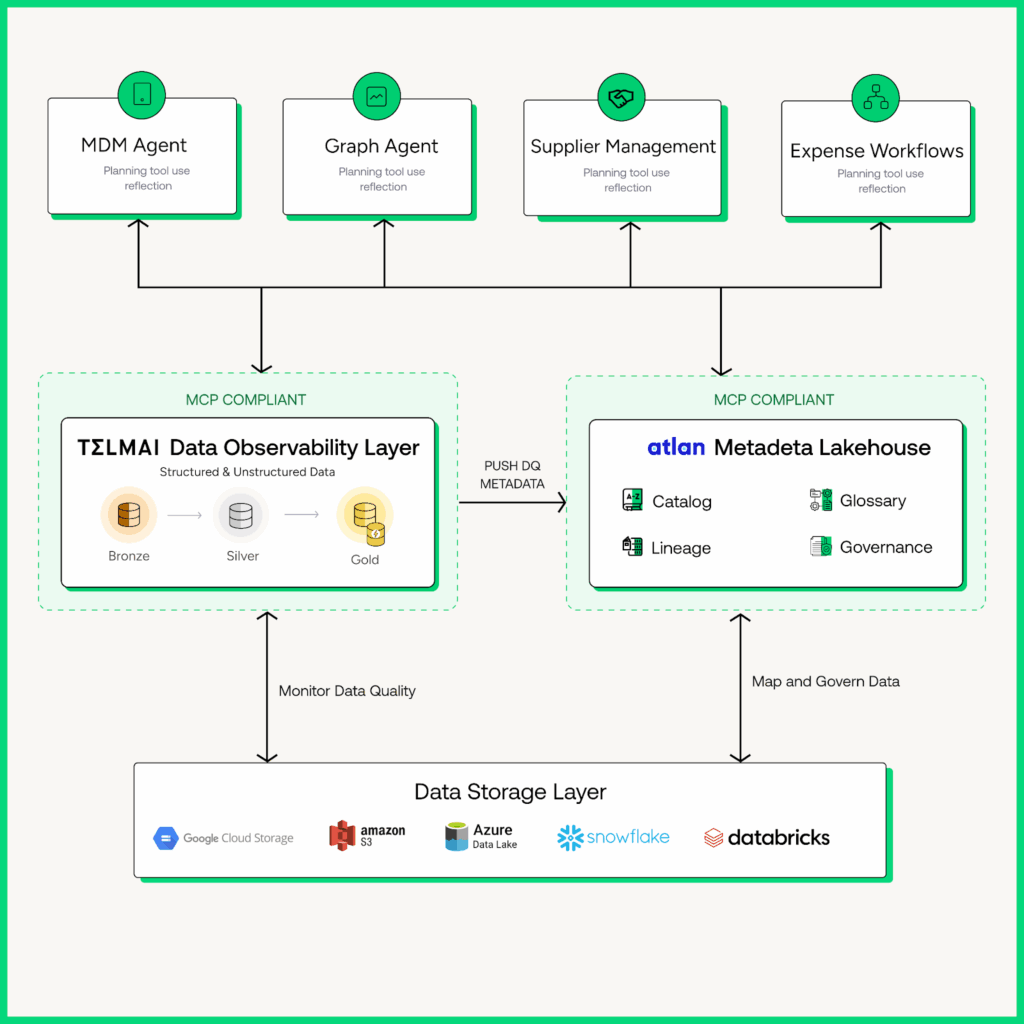
By combining Telmai’s AI-first data quality platform with Atlan’s AI-native metadata and governance platform through Atlan’s App Framework, enterprises gain a seamless way to detect, resolve, and govern data issues directly within the tools their teams already use.
In this article, let’s dive deeper into how they together create a single fabric of trust + context that allows enterprises to move beyond pilots and scale AI responsibly.
Why is real-time validation at ingestion critical for reliable AI?
The failure point for most AI initiatives isn’t in the model, but rather it’s in the underlying data pipeline feeding it. Business Intelligence (BI) is inherently deterministic and descriptive, working with structured historical data to explain what happened through predefined reports and dashboards. AI, in contrast, is non-deterministic and predictive. It consumes both structured and unstructured data to learn patterns, forecast outcomes, and make autonomous decisions.
The old adage “garbage in, garbage out” takes on far higher stakes here. AI and LLMs always identify patterns from the inputs they receive and derive insights without context or judgment. If those inputs are incomplete, drifting, or biased, the model confidently reproduces those flaws at scale.
Traditional data quality approaches were designed for a reporting world, where errors could be corrected after a dashboard broke or a KPI looked suspicious. AI-native workloads break this model entirely. AI and autonomous systems operate at machine speed, where thousands of micro-decisions are made every second. Waiting until the BI or monitoring layer to enforce quality is simply too late, as the damage has already propagated through to downstream business-critical applications.
That’s why ingestion-layer validation has become non-negotiable. Data quality must be ensured before Agentic workflows can access or read the data, not after the data lands in the access layer, at the data lake, or before it enters the lake through event streams. Reliability must be enforced as data is ingested into the lake, especially in open formats like Apache Iceberg and Delta Lake, where it is profiled and validated before being published to production tables.
This is exactly where Telmai comes in. Purpose-built for AI-first architectures, Telmai continuously monitors and validates data through your data pipeline, irrespective of volume or velocity. Telmai’s ML-driven and rule-based checks automatically detect anomalies, schema changes, and data drift before they impact production. Further, Telmai can publish data health KPIs into data catalogs and metadata systems like Atlan, enriching lineage and governance with real-time data quality context.
Agentic AI systems don’t have the luxury of waiting for late-stage fixes. They act in microseconds. That means trust must be built into data at ingestion, and that trust must travel with context across the enterprise, “ said Mona Rakibe, Co-Founder and CEO of Telmai. “With the App Framework, Telmai and Atlan will give teams a trusted data layer ready to power applications and integrations that let AI move beyond pilots and deliver at scale.”
How Atlan extends this trust with context
Trust in data is only half the story. For enterprises to scale AI responsibly, trust must travel with context so every consumer, whether human, system, or AI agent, knows what the data means, where it came from, and how it can be used.
As part of Atlan’s new App Framework, Telmai is now integrated directly into Atlan’s Metadata Lakehouse. For the first time, enterprises can unify monitoring within the same foundation that powers column-level lineage, business-ready data products, AI governance, and policy & compliance monitoring.
With this integration, customers using Telmai and Atlan can:
Unify trust and context in the Metadata Lakehouse – Telmai’s data quality signals, such as freshness, anomaly detection, schema changes, and volume drift, are automatically surfaced inside Atlan, enhancing lineage and metadata with actionable insights that empower data consumers and AI agents alike.
Enable true interoperability for agentic AI – For agentic systems to truly scale, interoperability is critical. The tools and services that agents depend on, whether for validation, access, enrichment, or downstream action, must be accessible through a common layer. Atlan delivers this through its open Metadata Lakehouse by providing consistent, versioned context across raw ingestion data and curated data products, ensuring data fitness can be evaluated at every step.
Enforce policy and compliance at scale – With Telmai’s data quality metadata embedded in the context layer, data trust signals can flow downstream via column-level lineage and bidirectional tag management to other platforms like Databricks, Snowflake, or data access systems. When Data Quality issues are encountered, they can trigger automated governance workflows, ensuring policy compliance and reducing risk across autonomous AI pipelines.
Enterprises can’t scale AI responsibly without a foundation of trust and context. Telmai brings real-time, ingestion-level validation, and Atlan serves as the context layer, ensuring that trust travels with context across every system, workflow, and AI agent.” said Marc Seifer, Head of Global Alliances at Atlan. “Together, Telmai and Atlan are enabling organizations to move beyond pilots and build AI systems that operate reliably, responsibly, and at scale.”
Get AI-Ready—Now
For enterprises to successfully transition AI pilots into production, they need real-time, low-latency access to validated data, along with metadata that carries context about its health, lineage, and governance. Without this foundation, AI agents operate blindly, lacking visibility into whether the data they consume is fit for use, where it originated, or whether they are authorized to access it.
Telmai and Atlan close this gap. Telmai continuously monitors and validates data in open table formats, such as Apache Iceberg and more, as it lands in the lake layer, detecting anomalies and data quality issues before they propagate downstream. It then generates rich observability metadata, which flows into Atlan’s Metadata Lakehouse. There, these signals are combined with lineage, policies, and business glossaries, providing a complete picture of data health and context for both humans and AI agents.
By bringing Telmai’s data quality signals into Atlan’s Metadata Lakehouse, enterprises can now drive measurable impact on their AI implementation with reliability and context fabric that enables AI to scale responsibly.
Want to learn how Telmai and Atlan can work together to scale your existing data infrastructure to be AI-ready? Click here to connect with our team for a personalized demo.
Want to stay ahead on best practices and product insights? Click here to subscribe to our newsletter for expert guidance on building reliable, AI-ready data pipelines.
GreenShift, an Amsterdam-based AI powered technology company revolutionizing sustainable cloud computing, has raised €2.35 million in a Convertible Loan Agreement (CLA) round. The investment was led by 4impact capital and The Footprint Firm with continued support from Rockstart.
The fresh capital will enable team growth and support GreenShift’s efforts to deepen enterprise partnerships, advancing its mission to become the operating system for sustainable cloud computing.
Tackling the urgent challenge of cloud emissions
The global cloud market is valued at over €900 billion and growing at a 21% CAGR. With cloud computing already generating more CO₂ emissions than the aviation industry, data centers are projected to account for up to 2.5 billion tons of CO₂ by 2030, nearly 40% of U.S. annual emissions. Today, cloud computing is estimated to account for roughly 2.5–3.7% of global greenhouse gas emissions. A significant share of this footprint is amplified by inefficiencies, such as idle provisioning, complex application deployment architectures that prevent easy cost and emissions attribution, and under-optimised application logic that reduce overall energy use effectiveness. This represents both a massive sustainability challenge and a strategic opportunity: without intervention, cloud and AI workloads will continue to drive unsustainable energy demand.
GreenShift’s solution: Full-stack visibility, real-time optimisation and carbon aware automation
Unlike existing solutions, many of which focus on infrastructure-level optimisation, GreenShift operates at the application layer, where most inefficiencies originate. GreenShift’s AI-powered platform reduces cloud application energy usage by up to 40%. By unifying cost, performance, and carbon into a single optimization engine, it enables organizations to lower emissions and significantly cut cloud costs while driving performance. Unlike traditional optimization initiatives that force a trade-off between cost and performance, GreenShift removes that compromise as well. The result is a step-change in cloud sustainability: lower costs, higher performance, and significantly reduced environmental impact.
Omar Regoort and Leonid Borodaev, Co-CEOs of GreenShift, stated:
“Our vision is to lead the global shift to sustainable cloud computing. By building the operating system for sustainable cloud, we ensure digital growth is efficient, high-performing, and green by default. With 4impact, The Footprint Firm, and Rockstart as partners, we’re in a strong position to accelerate adoption and scale our impact globally.”
Ali Najafbagy, Founding Partner at 4impact capital, said:
“The rapid increase in cloud computing leads to vast inefficiencies, high energy consumption and high emissions. GreenShift tackles this head-on with a scalable, software-first solution that reduces energy use while enhancing performance. Omar, Leonid, and their team are uniquely positioned to build the global category leader in sustainable cloud computing, and we are proud to lead this round.”
Sofie Käll, CIO at The Footprint Firm, commented:
“We are excited to back GreenShift in addressing the critical and growing issue of costly, and emissions-heavy computing. Their solution delivers a powerful alignment of operational, economic and environmental value for Enterprises – exactly what’s needed to make sustainable technology truly scale. We’re betting on a future where AI serves, rather than strains, the planet, and we truly believe Omar and Leonid of Greenshift are the ones to help realize that vision”
Gem Kua, Investment Manager at Rockstart, added:
“Backing Omar and Leonid in GreenShift’s stealth phase was about more than investing in technology – it was about backing founders who could tackle the AI era’s compute and emissions challenge. Their early deployments have already demonstrated strong results across sustainability, cost, and performance metrics, and we’re proud to back them again as they are on track to lead the sustainable cloud computing category.”
The GreenShift investment benefits from support from the European Union under the InvestEU Fund.
Today, we’re excited to announce that our SOSV portfolio company and HAX startup development program graduate Hyperlume, a pioneer in MicroLED-based optical interconnect technology, has been acquired by Credo (NASDAQ: CRDO).
This marks a major step forward in delivering secure, high-speed connectivity solutions that are more reliable, energy efficient, and ready for the AI era.
Impact on the AI World
The explosion of AI and hyperscale data center workloads is pushing existing connectivity infrastructure to its limits. Traditional electronic interconnects face serious energy and bandwidth bottlenecks that slow scaling and increase costs.
GPU performance has improved ~40,000x since 2000. But the networks that connect those chips have only improved ~80x, creating a significant bottleneck. Today, most GPUs still transfer data via copper cables, an antiquated method that’s cheap but highly inefficient (it generates excessive heat and wastes energy). Laser-based optical cables exist, but they’re 5x more expensive than copper and don’t scale well within tightly packed racks where 40% of the interconnects live.
To keep pace with the exponential growth of data, the world needs a new class of connectivity.
That’s where Hyperlume’s breakthrough MicroLED technology comes in. By using high bandwidth, low latency, low power interconnects for AI data centers and high-performance computing systems, Hyperlume has created a new way to overcome the energy and bandwidth bottlenecks inherent in traditional electronic interconnects.
With this acquisition, Credo now offers one of the most comprehensive connectivity platforms in the industry and strengthens their ability to help customers scale massive AI networks more efficiently and sustainably.
Huge congratulations to Hyperlume co-founders Mohsen Asad (CEO) and Hossein Fariborzi (CTO). When they first joined HAX in 2023, as part of our ever-expanding thesis into next-gen compute and data centres power, their mix of deep technical expertise and conviction is why we invested early.
Read more in Credo’s press release announcing the acquisition here.
Scale is excited to announce our investment in Inspiren’s $100M Series B!
By 2030, 1 in 5 Americans will be aged 65 or older, and without technology senior living communities won’t be able to safely keep up with demand. Inspiren is creating a safer future for older adults by helping senior living communities deliver safer, higher quality care through unifying resident safety, care planning, staffing, and emergency response into a single, AI-powered platform.
Today, senior living care teams are flying blind on critical details of patient care and rely on inaccurate care plans, midnight rounding, and some of the worst software you’ve ever seen to deliver care to incredibly vulnerable patient populations. Inspiren replaces guesswork with data by combining hardware and software to give care teams a real-time view of resident behavior they can use for both tactical care delivery and long-term planning. The end result? Safe residents, happy staff members, and financially prosperous senior living communities.
Inspiren is a case study in category creation and how impeccable execution can shift industry sentiment in a matter of months. We were first introduced to the business last fall and were immediately impressed with Alex and the value Inspiren was delivering to its early adopters. However, industry sentiment at large was mixed. Theoretical ROI was easy to grok, but operators burned by past generations of technology over-promising and under-delivering had concerns about product quality and resident privacy. Fast forward eight months and industry sentiment had totally flipped: Inspiren is the obviously better way to run a senior living community.
So what changed and convinced operators that Inspiren should be the new standard of care? At the core of Inspiren’s success is privacy-first design driven by tight coupling between hardware and software. When a community adopts Inspiren, sensors are installed in resident’s rooms that monitor activity and alert nurses when residents might be in trouble. To be clear, these aren’t security cameras: they’re beautiful, unobtrusive devices that leverage audio, visual, and radar inputs to create a privacy-preserving digital twin of every resident. Care teams get exactly the right amount of information to help residents when they need it and residents don’t feel like they’re living under a surveillance state.
Informed care teams are effective care teams and Inspiren’s data helps create safer communities. This is particularly important when resident needs change rapidly. When residents join a community, there’s an initial medical evaluation that determines a care plan based on their needs. However, resident health can change meaningfully in a matter of weeks. In the current state, care teams will recognize that and start ad-hoc delivering more care, but without a formal re-evaluation the care plan won’t be rigorous, and the community won’t be compensated for the increased care levels. Inspiren changes that. Data from Inspiren’s sensors is fed back into their software platform and will proactively flag residents who might need increased care. Inspiren’s clinical team reviews that data with communities and together they make sure that all residents are getting the care they need with financial arrangements that make sense for the community. The results are stunning: Inspiren customers are seeing 80%+ reductions in bedroom-related falls with an injury.
Inspiren is the latest of many bundled sensors and software deals in our portfolio and joins the likes of Motive, Locus Robotics, Spot AI, VergeSense, and others injecting intelligence into real-world operations. A hard-earned learning of ours is that it’s incredibly difficult to build a sensor + software platform that delivers hard ROI to customers at a price point that makes the unit economics work for the business. Alex, Michael, and the rest of the Inspiren team have done exactly that and are helping some of the largest senior living communities better serve thousands of residents and their families. We’re honored to be a part of their mission.
Scindo develops enzymes—nature’s tiny biological catalysts—that can transform a wide range of feedstocks into ingredients that have historically been sourced from petrochemicals.
Founded in 2020 by Dr. Gustaf Hemberg, Dr. Ben Davis, and Juliet Sword, Scindo combines AI models with proprietary data to accelerate enzyme discovery and optimization.
The firm, which has established partnerships with leading specialty chemical manufacturers, develops enzymes for several industry verticals including food and flavorings, cosmetics, and specialty chemicals.
With the new funding, it will expand its platform, scale wet-lab capabilities and strengthen its team.
“The specialty chemicals industry has long sought to move away from petrochemical-derived ingredients, but existing approaches have struggled with complex natural feedstocks,” said Ali Morrow, partner at lead investor Clay Capital.
“Scindo’s approach creates molecular craftsmen: enzymes designed for specific industrial jobs that offer cost-competitive natural alternatives and unlock previously inaccessible feedstocks, creating significant opportunities globally to end the industry’s reliance on crude oil.”
Designer enzymes
Scindo CEO Gustaf Hemberg told AgFunderNews: “When we started, we focused on mapping enzymes with functionalities that are difficult to achieve selectively with traditional chemistry and relatively uncommon in nature—particularly C–H activations and C–C bond cleavages [thereby opening up route for degrading stubborn molecules such as plastics].”
“By discovering and characterizing these underexplored enzymes, we built datasets that could be fed into our machine learning models—not only to identify new enzymes with previously unknown functionalities, but also to enable generative design of novel enzymes with entirely new capabilities.
“That’s really at the core of what we do: by gathering new examples and generating proprietary datasets of enzymes with novel and defined functionalities and selectivities, we enable our machine learning models to learn which parts of the sequence or structure drive the performance or selectivity that we’re targeting.
“And that’s the real challenge with public datasets—they’re concentrated on a few well-studied enzyme families with narrow, specific functionalities. They’re often incomplete and sometimes even contain mischaracterized examples, which makes them limiting when training models for prediction or generative design of enzymes for novel transformations and the specific applications that we are targeting.”
Once Scindo has identified suitable candidates, it engineers these enzymes further—first to optimize selectivity and transformation efficiency, and then to improve physical traits such as thermostability and expressibility, said Hemberg. Scindo also collects and enriches its predictive models with rich metadata to identify candidates most likely to scale in industrial settings and express at high yields in microbial systems. This ensures maximum viability for rapid scale-up and collaboration with manufacturing partners, he explained.
“We have quite a big chemistry screening platform, so we are able to test the enzymes in the lab, characterize them and then feed that data back into the machine learning. Closing the loop between real life results and machine learning has been really critical for us.”
Once it has tested some candidates, it can do further work to rank them based on viability for scaling up in a microbial expression system and then work with an enzyme manufacturer to scale up production, said Hemberg.
Cell-free biomanufacturing
Scindo’s first two products are enzymes that can create key building blocks of flavors & fragrances, and enzymes that can enable cost-effective petrochemical-free production of a high-value cosmetic ingredient via cell-free biomanufacturing.
In the case of flavor and fragrance ingredients, he said, “We can use a wide range of agricultural fatty acid feedstocks and have designed enzyme systems that selectively convert them into flavor molecules. We’re now advancing into pilot-scale production through a partnership we haven’t yet announced.
“Some of those flavor ingredients could be produced with precision fermentation [by engineering microbes to express them in costly steel fermentation tanks], but that is much more expensive [than using a cell-free approach just using enzymes], the titers are quite low, and you generate a lot of waste metabolites.”
By using a cell-free approach that utilizes the internal machinery of microbial cells (such as enzymes) to convert feedstocks into the target flavor molecules, Scindo can significantly reduce production costs, he claimed.
Operating outside the constraints of a cell—and without relying on costly cellular cofactors—allows Scindo to run faster reactions across a wider range of conditions, such as pH and temperature, and in ways that significantly reduce energy consumption as there is less heating and cooling required, he explained. It also generates cleaner products that require less costly downstream processing.
“We’re hoping to target a market launch in the next 12 months or so for our first two products.”
Proprietary data sets
Stepping back, he said, the world’s largest enzyme companies tend to concentrate on a few specific enzyme families for traditional applications, particularly in food, laundry detergents, and some pharma applications.
“We are instead focusing on novel applications that have historically been much more difficult to target with traditional chemistry and enzymes alike.
“Our key differentiator is the proprietary data we’ve built around novel enzymes—their functionalities, specificities, and characteristics—with broad applicability to carbon-chain transformations. That’s really what separates us: we’re working with data that isn’t publicly available.”
A few months ago, a close family member of mine needed a routine medical procedure. The care team was ready. The facility had an opening. But the entire process was put on hold while the office staff chased down a prior authorization from the insurance company. Days of back-and-forth. Hours of staff time. And in the meantime, unnecessary anxiety for my family.
Unfortunately, this is not an unusual story. It’s the reality of a system where a third of the healthcare workforce is dedicated to administrative tasks, costing over $450 billion annually. Endless phone calls, long hold times, and redundant processes eat up resources that should be directed toward patients.
That’s why we’re so excited about Prosper AI, which today announced a $5 million Seed round to bring voice AI agents purpose-built for healthcare to market. Emergence is proud to lead the round, alongside Y Combinator, CRV, and Company Ventures.
Prosper is working with industry leaders like a 30,000-employee billing company to transform their core operations. In speaking to customers, we consistently heard that voice AI is the biggest innovation in the healthcare revenue cycle management area since the EHR, and that Prosper’s product was the best in market. This customer love is driving rapid growth, as Prosper has more than quadrupled revenue since last quarter.
Prosper co-founders Xavier de Gracia and Josep Mingot met in Boston while studying at MIT and Harvard, and their backgrounds in call centers and regulated industries uniquely positioned them to build AI agents for healthcare’s most complex workflows.
When I think back to that delayed procedure, I can’t help but wonder how different the experience could have been if Prosper’s agents were already deployed. Faster authorizations. Less stress. More care delivered on time.
Healthcare should be about patients, not paperwork. That’s the future Prosper AI is building—and why we’re so proud to partner with them on the journey.




%20(1).jpg)